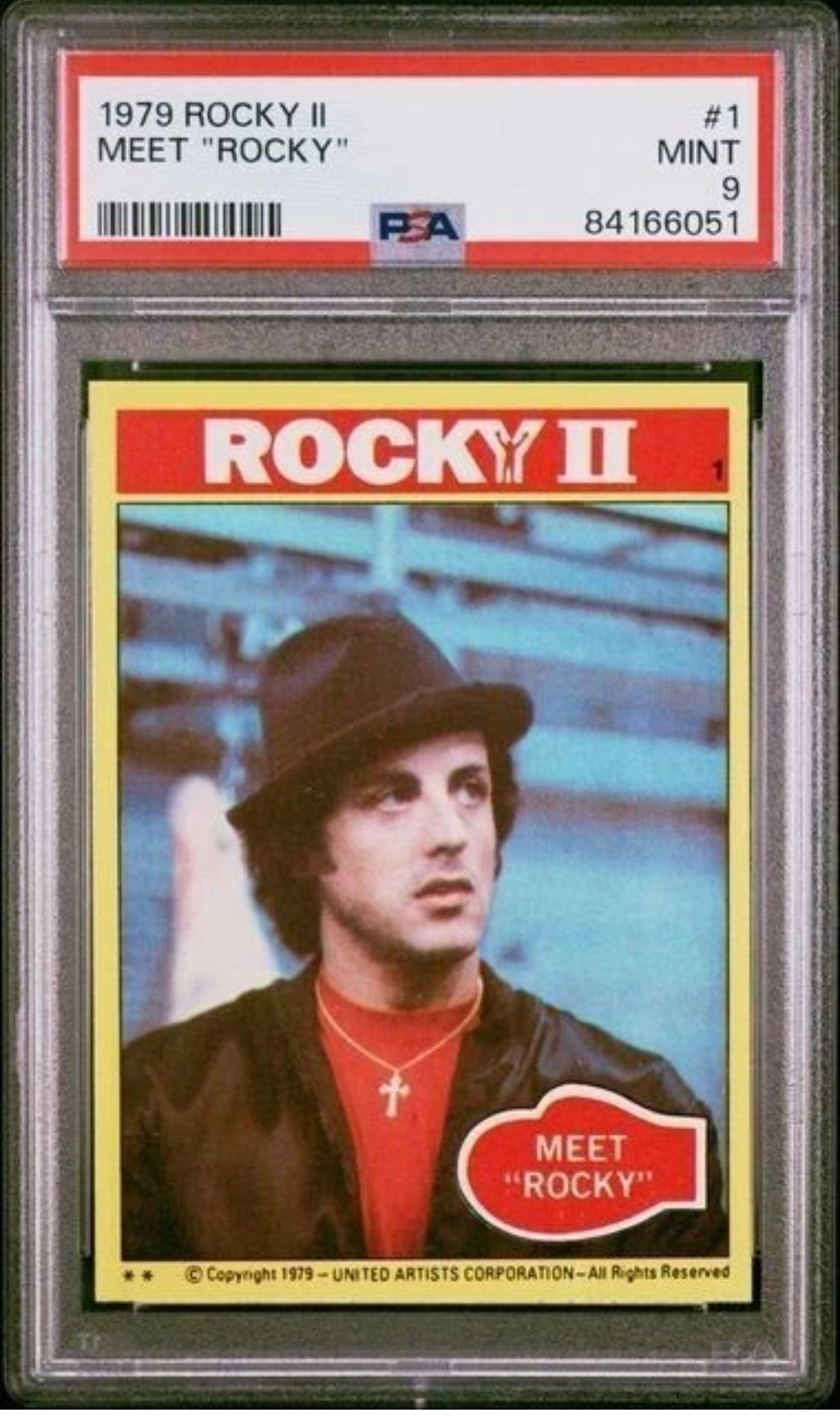
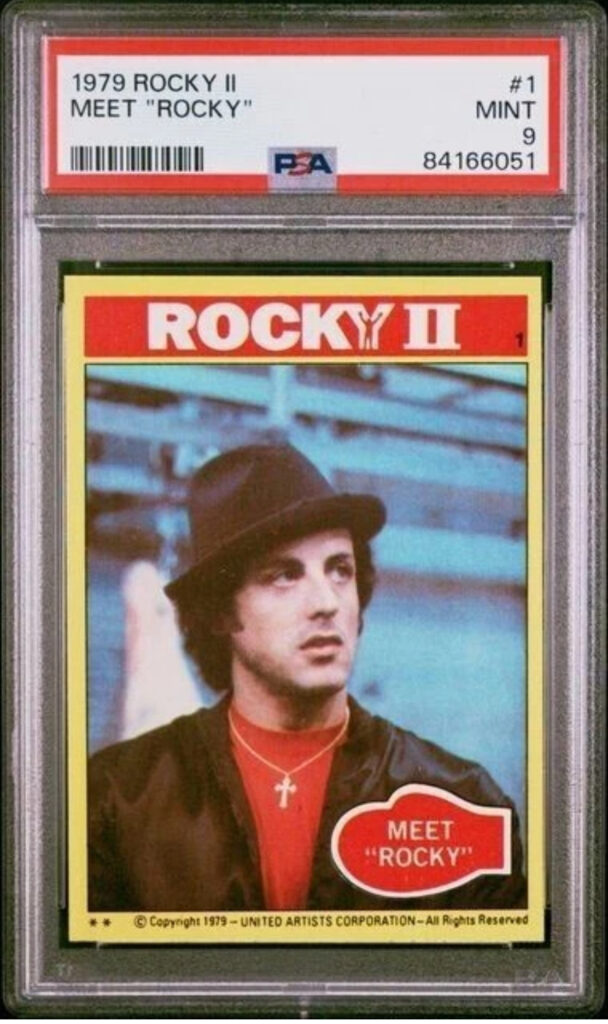
Iconic Rookies: 1979 Topps Rocky II #1 – Meet “Rocky”
When most collectors hear “rookie,” they go straight to sports: Gretzky, Jordan, Brady, Trout.
But if you hang around the non-sports side of the hobby long enough, you realize some of the most important rookies belong to characters, not athletes. The first time an iconic character shows up on licensed cardboard? That’s a rookie, whether the hobby wants to admit it yet or not.
In this Iconic Rookies series, we’re looking at those character-first debuts. After starting with Indiana Jones, we’re stepping into the ring for a blue-collar, South Philly classic:
1979 Topps Rocky II #1 – Meet “Rocky.”
Why #1 “Meet Rocky” Is Rocky’s Rookie Card
Rocky (the original film) came out in 1976, won a pile of awards, and became an underdog template for the next 50 years. But there was no trading-card set for that first movie.
It wasn’t until the sequel, Rocky II, that Topps stepped in and gave Balboa the full wax-pack treatment with a dedicated trading card set in 1979. That makes 1979 Topps Rocky II effectively the first mainstream Rocky trading card release.
Card #1 sets the tone for the entire checklist: “Meet ‘Rocky’”. It’s the headline introduction to the character on cardboard — an image-forward shot of Sylvester Stallone as Rocky Balboa with his name right there on the front. As far as character rookies go, you can’t really ask for a cleaner “this is the guy” first card.
If you buy the idea that character rookies should be defined by the first proper, licensed appearance of the character in a trading-card set, then this is it for Rocky.
A Quick Look at the 1979 Topps Rocky II Set
Some context on the set around this card:
- Manufacturer: Topps
- Year: 1979
- Set Size: 99 base cards, released as a single series
- Theme: Characters and key scenes from Rocky II
The base set walks through the movie with a mix of character introductions and stills from the film. Card backs feature bright colors, write-ups that recap the story, and in some cases puzzle pieces — classic late-70s Topps movie-set vibes.
On top of the main run, Topps also issued a separate Rocky II sticker set with 22 different stickers, giving collectors another Rocky lane if they want to go full-completionist.
PSA Pop Report & Auction Links
If you want to see how many copies have been graded and what the market has actually paid for them, here are some direct PSA links you can use:
-
1979 Topps Rocky II – #1 Meet “Rocky” (card-level auction & pop):
PSA Auction Prices / Pop – 1979 Topps Rocky II #1 Meet “Rocky” -
1979 Topps Rocky II – full set population report:
PSA Pop Report – 1979 Topps Rocky II (Set) -
1979 Topps Rocky II – full set auction results overview:
PSA Auction Prices – 1979 Topps Rocky II (All Cards) -
1979 Rocky II Stickers – sticker set population report:
PSA Pop Report – 1979 Rocky II Stickers (Set)
Between those pages you can see how many copies of #1 exist at each grade, how top-heavy the population is in 8s and 9s, and what kind of real-world prices bidders have actually stepped up for.
What’s Actually On Card #1?
Card #1 is doing exactly what the caption says: introducing you to Rocky Balboa.
You get a prominent photo of Stallone as Rocky, framed in that late-70s Topps movie style, with the text “Meet ‘Rocky’” up front. It’s not a crowded group shot or a distant ring scene — this is a clear, character-first image. If you’re building a binder page of “this is the character’s rookie card,” this belongs right in the middle row.
From a “does this feel like a rookie?” perspective, it checks all the boxes:
- Card #1 in the checklist
- Directly named after the character
- Focuses on the character himself, not just a random frame from the movie
Condition & Grading: An Accessible Icon
1979 Topps movie cards were printed for kids, not slabs. They were meant to be ripped, traded, and thumbed through with bubble-gum fingers. So while raw copies of Meet “Rocky” are not exactly rare, high-grade examples are still a little bit of a hunt.
Things to watch for:
- Centering: Classic late-70s Topps issues apply here. Left-right centering can get rough.
- Corners & edges: Even minor wear stands out once you’re chasing 8s, 9s, and 10s.
- Surface: Print snow, minor scratches, and handling marks will separate “nice raw” from “grade-worthy.”
The PSA population report shows several hundred copies of #1 across all grades, with a healthy chunk in PSA 7–9 territory and far fewer true top-end gems. High-grade examples have seen strong auction activity for a non-sports card of this era, with realized prices running from the low tens for beater copies up into the mid-three-figure range when the grade and eye appeal line up.
In other words: it’s absolutely collectible, but it’s not so scarce that you can’t participate. You don’t need a championship purse to get a nice example.
Building a Rocky PC Around This Card
If you’re a character-first collector, this card is the obvious anchor for any Rocky PC:
- Start with #1 Meet “Rocky”: Grab a clean raw copy or aim high and try to land an 8 or better.
- Add key supporting characters: Adrian, Apollo, Mickey, etc., all have their own cards in the set.
- Layer in the stickers: The 1979 Rocky II sticker run gives you an extra lane of vintage Rocky cardboard to chase.
From there you can branch into later Rocky and Creed-era releases, oddball promos, international issues, and so on. But if you want a single card that says “this is where Rocky started on cardboard,” it’s #1 in this 1979 Topps set.
Why This Matters for Iconic Rookies
Zooming back out, this is the whole point of the Iconic Rookies concept: treating pop-culture characters with the same seriousness we give to sports rookies.
Rocky Balboa isn’t just another movie character. He’s shorthand for the underdog archetype. He’s a cultural reference point that’s outlived multiple generations of actual fighters. People who’ve never seen the film still know the steps, the music, the training montage.
Yet 1979 Topps Rocky II cards are still relatively under the radar compared to what has happened to sports issues from the same era. That’s the opportunity. Character rookies like this are where pop culture and cardboard meet in a way that the market hasn’t fully priced in yet.
If you already own a copy of 1979 Topps Rocky II #1 – Meet “Rocky”, this is your reminder to appreciate it like the character rookie it is. If you don’t, it might be worth going a few rounds on the auction floor to see if you can pick one off before the judges’ scorecards catch up.
Leave a Reply
You must be logged in to post a comment.